Why can a hydraulic wrench easily handle a large bolt that can't be turned by hand?
I still remember the photo a maintenance lead sent me last winter. It showed a 4-inch stud on a gas compressor cylinder head, a 10-foot cheater pipe bent like a banana, and three guys standing around it with that mix of exhaustion and defeat you only get after an hour of sledgehammering a slugging wrench. His message read: “We can’t break it loose. What do you suggest?”
That picture is worth a thousand words, and it answers the question right in the title. A hydraulic torque wrench doesn’t just add a little more muscle to the job — it fundamentally changes how force is generated, controlled, and transferred to the bolt. And once you understand that difference, it becomes obvious why a tool you can carry in one hand will spin off a bolt that three people on a 12-foot snipe cannot.
The physical limits of hand turning
Let’s put some numbers on the table. A strong, healthy technician leaning on a 1.5-meter (5-foot) pipe can generate somewhere around 250–350 Nm of torque in a sustained pull. You can push that closer to 500 Nm if someone else jumps on the bar, but now you’re in uncharted territory: sockets crack, studs gall, and the risk of a slip-and-fall injury skyrockets. On large flanges — think ANSI 900# and above, or wind turbine yaw decks — a single bolt often calls for 6,000 Nm, 15,000 Nm, or even 40,000 Nm. That’s not a gap you close with a longer handle. It’s a different league entirely.
Manual torque multipliers (the planetary-gear boxes you attach a regular torque wrench to) can bridge part of that gap on paper, but they still demand a steady human input. At a 5:1 ratio, reaching 6,000 Nm means you need to put in a clean, uninterrupted 1,200 Nm by hand — which is already beyond what most people can deliver without a reaction fixture. And the moment your arm stutters or the tool cocks sideways, the torque reading is gone and the risk of a misloaded joint climbs.
How a hydraulic wrench turns hydraulic pressure into “effortless” torque
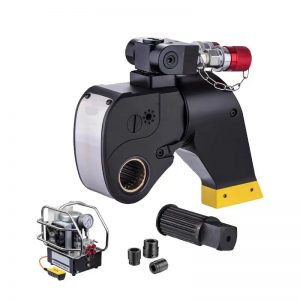
The core of a hydraulic torque wrench is a cylinder, a piston, and a ratchet mechanism (or a hex cassette in low-profile models). When the pump pushes oil into the cylinder at up to 10,000 psi (700 bar), that pressure acts on the piston area and produces a linear force that can easily reach several tons. That force pushes against a reaction arm that is braced against a neighboring bolt, a flange edge, or a dedicated reaction point. Because the reaction arm is locked against a stationary object, all that linear force is converted into a rotational movement of the drive head — with no kickback reaching the operator.
Think of it like a hydraulic bottle jack lying sideways and turning a socket. Your hand on a cheater bar has to absorb every bit of the reaction torque yourself; that’s why a stuck bolt can throw you off a ladder. A hydraulic wrench hands the reaction job to a steel arm that is deliberately rested against something immovable. The technician stands clear, presses a button on a pendant, and the pump cycles smoothly until the preset pressure — which corresponds to a known torque — is reached. After that, the wrench either stalls or the pump auto-shuts off, depending on your setup. The process is calm, quiet, and crushingly powerful all at once.
Why it feels “easy” even on bolts that laugh at a sledgehammer
There are three reasons:
Force multiplication that doesn’t come from your back. A medium hydraulic torque wrench with a 6-inch reaction radius and a cylinder force of 10 tons delivers around 6,000 Nm effortlessly. The only human effort is positioning the tool and pressing a remote control. You can hold a conversation while a 10.9-grade M64 bolt tightens to its final spec.
Smooth, continuous motion without impact. Impact wrenches beat the bolt and the socket to death and give you little control over final torque. A hydraulic wrench applies torque in steady, measurable increments — typically 25° to 35° of rotation per stroke — and stops exactly where you set it. That predictability is why flange integrity engineers love these tools: you get uniform bolt load across all studs, which is crucial for leak-free gasket seating.
No need for heat, hammers, or hope. Anyone who has heated a seized nut with a rosebud torch and then hammered a striking wrench until the hex rounded off will appreciate the sheer civility of walking up with a hydraulic cassette, sliding it onto the nut, and letting the pump do the work. It protects the fastener, the flange, and the people.
The buying lens: what procurement teams and maintenance leads really need to know
If you are purchasing hydraulic torque wrenches for a plant or a service fleet, the conversation quickly moves from “how it works” to “will it earn its keep.” These are the points that tend to matter most during evaluation:
Torque accuracy and traceability. A quality hydraulic torque wrench delivers repeatability within ±3 %, and when paired with a calibrated pressure gauge or an in-line torque transducer, you have a documented trail for every joint. For oil & gas, nuclear, and wind energy applications where an audit may ask for bolt-up records, that’s non-negotiable.
One pump, many tools. A single 10,000 psi electric or air-driven pump can run multiple wrenches simultaneously. That means you can tighten four bolts at once on a flange — drastically cutting vessel closure times — with a synchronizing manifold that keeps all tools on the same torque plane. When maintenance hours are measured against lost production, the payback is often measured in weeks, not years.
Operator safety and fatigue. No exposure to pinch points when used correctly, no pinch bars flying across the deck, and hearing protection that’s a nice-to-have rather than a must. The reduction in strain injuries alone can justify the capital spend for many heavy-industry maintenance departments.
Tool longevity and low drama. A well-made hydraulic wrench doesn’t ask for much: keep the hydraulic oil clean, swap the seals every couple of thousand cycles, grease the ratchet linkage, and it will still hit its torque spec years later. Compare that to the cost of outsourcing hot-bolting crews or the downtime caused by a hammered stud that snaps mid-outage.
What actually matters when you spec a wrench. Bolt diameter is only the starting point. You need the precise torque value from the joint designer (lubricated or dry, too — friction coefficient changes everything). Then you look at the space envelope: can you fit a standard square-drive wrench with a socket, or do you need a low-profile hex cassette to get onto a flange where the bolt pitch is tight? Ask your supplier to bring a demo tool to your toughest application. The tool that looks good in a catalog may not fit around the pipework next to your heat exchanger.
Where it shines vs. where it’s overkill
I won’t pretend a hydraulic wrench is the answer to every stuck bolt. For a maintenance shop that works mostly below M30, a quality torque multiplier or a calibrated clicker wrench is often the faster, cheaper pick. But the moment you cross into M36 and above on critical joints — cylinder heads, pressure vessel manways, rudder stock bolts, wind turbine blade studs, compressor tie rods — the hydraulic torque wrench stops being a luxury and becomes the only safe, sane way to hit your numbers.
One refinery client told me they reduced a 14-hour heat exchanger bundle changeout to under 5 hours after switching from manual slugging to a dual-wrench hydraulic setup. Fewer people in the hot zone, no rework on leaking flanges, and a torque record that went straight into the CMMS without a single sheet of paper. That’s the “easy” that procurement cares about: it’s not just the bolt that turns faster, it’s the entire maintenance workflow.
Making the decision without the fluff
If you’re reading this with a purchasing hat on, here’s a short checklist:
Request a torque-versus-pressure chart from the manufacturer and verify it against a calibrated torque analyzer before accepting delivery.
Make sure the reaction arm geometry works for the flanges, couplings, and housings in your plant — universal arms are handy, but custom arms can be the difference between a smooth job and a frustrating one.
Look at the accessory ecosystem: swivel couplings, dual-hose sets, booted sockets for safety, and a robust case that protects the tool when it’s living in a truck or a rig locker.
Ask about turnaround on seal kits and calibration support. The best wrench in the world is a paperweight if you can’t get it recertified before the next turnaround.
The core idea is simple: a hydraulic torque wrench makes a huge bolt easy not because it’s “stronger” in some abstract sense, but because it puts the reaction force into the structure instead of the person, amplifies the operator’s input a thousand-fold through fluid power, and stops at exactly the torque the engineer specified. When you’ve watched a green apprentice tighten a 2¾-inch stud to 8,000 Nm with one finger on a remote, the concept really clicks — and no cheater pipe will ever look the same again.