Pleated filter element
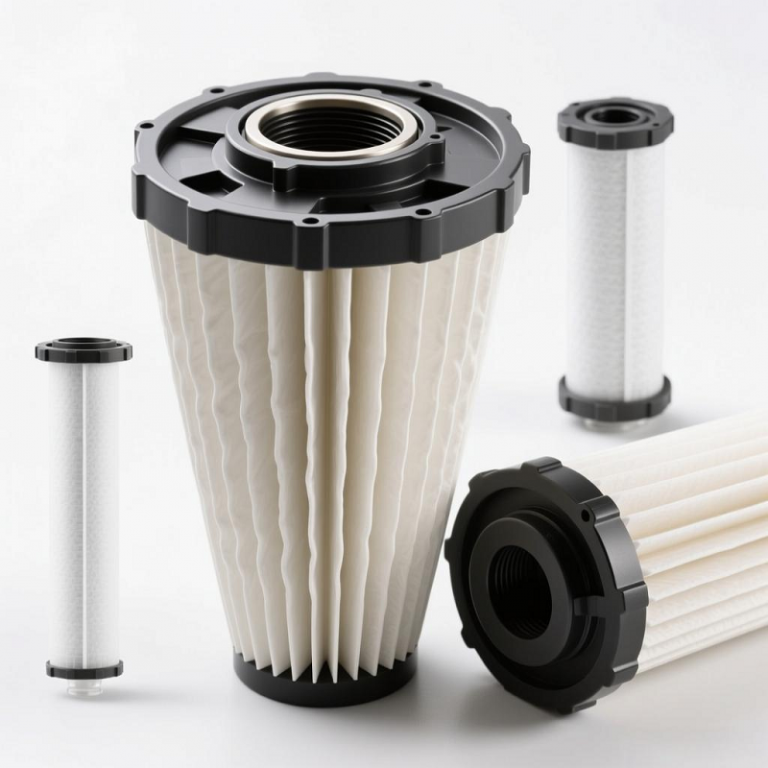
A pleated filter element is a type of filter cartridge constructed from a sheet of filter media that is folded into a series of uniform ridges and grooves (pleats). This design dramatically increases the available surface area for filtration within a given housing or cartridge size.
The pleated filter element is a versatile, efficient, and compact solution for a vast array of solid-liquid and solid-gas separation tasks across virtually all industrial sectors.
| Material | Specification | Advantages | Application |
| Polypropylene (PP), polyethersulfone (PES), nylon, polyvinylidene fluoride (PVDF), etc. | A precision filter element is assembled by repeatedly folding flat sheet filter media (such as filter membranes) into a wavy or serrated shape, and adding a support layer and protective mesh (end caps, central skeleton, etc.). | By folding, the filtration area can be 5 to 10 times larger, or even more, than a flat-panel filter of the same size, within a limited volume (e.g., 10 inches long, 2.5 inches in diameter). The efficiency range is wide, from coarse filtration to absolute sterilization. | Pleated filter cartridges are the "heart" of modern industrial and domestic filtration technology. Through their ingenious pleated design, they perfectly balance the four key factors of filtration area, efficiency, resistance, and service life, making them a benchmark product for achieving high-efficiency and precision filtration. |
Key Features and Construction
Pleated Media: The core component. The media sheet is folded into accordion-like pleats.
Support and Drainage Layers: Often, non-woven mesh or scrim layers are placed on one or both sides of the main media. These provide structural support, prevent pleat collapse, and aid in fluid drainage.
End Caps: The pleat pack is sealed (usually with polyurethane or hot-melt adhesive) into plastic or metal end caps. These caps center the element in the housing and create the seal between the unfiltered (dirty) and filtered (clean) sides.
Core: A cylindrical perforated metal or plastic core in the center provides internal strength and acts as the outlet for the filtered fluid.
Cage/Shroud: An outer protective cage (often stainless steel or plastic) is sometimes used for high differential pressure applications or to protect the media during handling.
Advantages of the Pleated Design
High Dirt-Holding Capacity: The increased surface area allows the filter to capture and retain a large amount of contaminant before becoming clogged, leading to longer service life.
Low Pressure Drop: Because the flow is distributed over a large area, the initial resistance to flow (pressure drop) is lower compared to a cylindrical depth filter of the same size.
High Filtration Efficiency: The media can be precisely selected for its particle capture characteristics (e.g., absolute or nominal ratings) across a wide range, from 0.1 µm to over 100 µm.
Space Efficiency: Achieves a large filtering surface in a compact, cylindrical form factor.
Common Filter Media Used
The choice of media depends entirely on the application:
Membrane (Polypropylene, PTFE, Nylon): For critical, absolute-rated filtration in pharmaceuticals, electronics, and food & beverage. Provides precise particle removal.
Glass Fiber: High temperature tolerance, high efficiency, often used in compressed air, gases, and industrial processes.
Cellulose (Paper): Cost-effective for general purpose filtration of oils, fuels, and coolants. Often blended with synthetics for improved durability.
Polyester, Polypropylene (Non-Woven): Versatile, chemical-resistant synthetic media used in many industrial liquid and air applications.
Activated Carbon: For odor removal, dechlorination, and organic adsorption (often as a composite layer).
Selection Considerations
When choosing a pleated filter element, engineers must specify:
Filtration Rating: Absolute or nominal micron rating (e.g., 1 µm, 10 µm).
Media Type: Compatible with the fluid (chemical compatibility) and suitable for the required efficiency.
Dimensions: Length, outer diameter (OD), inner diameter (ID) of the end caps.
End Cap Style & Seal Type: O-ring, flat gasket, threaded, etc. (e.g., 222, 226 O-ring, double O-ring).
Differential Pressure Limits: Maximum allowable pressure drop across the element.
Operating Conditions: Temperature range, flow rate, and system pressure.
Industry Standards: Compliance with relevant standards (e.g., FDA, USP Class VI for food/pharma, ISO 8573 for compressed air).
Maintenance
Pleated filter elements are typically replaceable cartridges. They are serviced by:
Isolating and depressurizing the filter housing.
Opening the housing and removing the spent element.
Cleaning the housing bowl.
Installing a new, correct element, ensuring seals are properly seated.
Closing the housing and checking for leaks.
The element is discarded when its pressure drop increases to a pre-set terminal level, indicating it is fully loaded with contaminant.
Typical Applications
Liquid Filtration:
Process Water & Ultrapure Water: Pre-filtration and final polishing.
Food & Beverage: Wine, beer, oils, syrups, dairy.
Pharmaceuticals: Process fluids, solvent filtration, venting.
Chemicals & Coatings: Additive removal, product clarification.
Hydraulics & Lube Oil: Particle removal to protect sensitive machinery.
Fuel & Oil Filtration: In engines and power generation.
Air/Gas Filtration:
Compressed Air & Gases: Removing oil, water, and particles downstream of compressors.
HVAC: High-efficiency final filters in cleanrooms and hospitals.
Engine Intake: For turbines and heavy machinery.
Vent Filters: On tanks and reactors.
Contact Information
- Email
- Tel
+86 18018607834
- Address
No. 779 Changhong Rd.,
Baoshan District, Shanghai China